Sunday, February 1, 2026

Ravenswood Presbyterian Church - 4300 N Hermitage Ave

 We're going to have to go posthumously (postarchitecturally?) on this one. As this blog post is written, the walls have already fallen on Ravenswood Presbyterian, and the last stones have been tidily rounded up into plastic-wrapped pallets for resale.


October 2025 was a bad month for vacant Chicago churches- perhaps unsurprising for the spookiest month of the year. Almost one after another, demolition permits fell for both Ravenswood Presbyterian, and the even older Christ Lutheran in Logan Square. While I was able to snag photos of both, I got much more complete coverage of Ravenswood, and for coverage of Logan Square I can happily direct you to Postcard-Past's wonderful writeup.
When I arrived on November 1st, the green demolition fencing had already gone up, somewhat thwarting my efforts to get a "clean" complete survey of the building. I'm very happy with the first shot however- the fall colors helped create a really beautiful scene.

Obscured by the fencing was the building's cornerstone, which attested the building was built 1914, and I was able to turn up contemporary newspaper reports that the new chapel was formally dedicated on March 28th, 1915, by pastor Frederick R Seldon. Valued at an impressive $82,000, (roughly $2.6 million in flimsy modern day funbucks), it partially replaced a 1906-1907 structure the congregation had used previously. This was technically the congregation's third home however, as they had first organized in 1902 and met at the now-lost Library Hall.


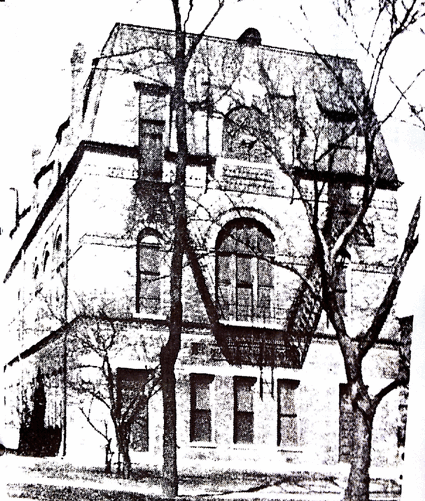
Little is known about this first iteration- I was able to track down this photo from the Chicago Public Library's collection, which claims to be Ravenswood Presbyterian at Cullom & Hermitage, but it carries very little information (not even a date), and it scarcely resembles a church at all. My best guess is that this is the 1906 structure, possibly in it's later use as a supplemental facility, and the oddness comes down to poor photography and reproduction over the years.


I think our best chance at an "as built" of Ravenswood Presbyterian is to turn to the architect's other works. Pond & Pond was quite prolific, and three years later they built another Presbyterian church, this time in Albany Park, which survives largely intact as a mosque. While not exact replicas, the buildings share a very similar shape, and I want to make special note of the similarity of the pane windows along the side.

Chicago Tribune, May 5th, 1949

The church was heavily rebuilt in 1949, demolishing the old parish house to add a 2-story annex, and re-cladding the main church in lannon stone, at a cost of $300,000 ($4.1 million, adjusted). The early rendering shown here is interesting as a lot changed between this sketch and reality- notably, no unexposed brick survived the remodel in the end, and the stone used was of a irregular, cobbled type, rather than the stone blocks seen used primarily as an accent here.

The church continued on through the decades as the neighborhood shifted; an anecdote in a Chicago Tribune article claims that in 1979, the church had a congregation of about 500, still mostly white, but that the church had welcomed it's first Hispanic members in 1968. By the time that article was written in 2003, the church's congregation, shrunk to 150, was now predominantly Hispanic, and the church's services were fully bilingual. A 2008 article even discusses the church opening it's doors to the LGBT community, which feels pretty progressive for the time; the church itself had adopted the moniker "The church of the open door" to reflect these policies, though the congregation continued to dwindle- down to 110 by that later article.

By 2024, the church made the decision to sell, joining with Mayfair Presbyterian, another stone-clad church further on the NW side. While they'd kept their head above water, maintenance costs mounted for such a large property, and the Hispanic families that had come to redefine the church had mostly been forced out as Ravenswood harshly gentrified. The church was first put up for sale in October 2024, and finally sold in June 2025 for $4.375 million.
Peeking over the fences, I still managed to line up some detail shots. Sadly, based off demolition photos, none of these windows or doors were salvaged, and were all destroyed.


Demolition wouldn't start for a short while, but an excavator had already taken up residence in the parking lot behind the building. However, this humble parking lot would turn out to be an unexpected boon, but we'll get to that in a second.


Our last view behind the fences is the only one  not coated with green demolition netting, standing in front of a small church garden. For some reason this in particular struck me as really sad- obviously the whole property was the product of many people's massive efforts (the inflation-adjusted millions to build and rebuild it for starters), but this garden was probably one or two people's baby, specifically. And here it sits, left to seed and now churned under the soil for suburbia in the city, that probably won't even have flowers in the front yard.


Through some incredible luck, a series of unlocked gates let me into the church property, including the church interior, which had sat fallow since the congregation left in late 2024. Above is the caretaker's house, a cute & squat little structure, likely built as part of the 1949 renovation. Sitting at the edge of the property, it was also the first to fall, being totally gone by December 10th.
Access to the rest of the property came via this passageway in front of a sunken courtyard, a fun architectural flourish, meant to provide natural light per an article on the 1949 renovations. That article also called this a "sunken garden", so perhaps the stone pavers were a later addition when that became too high maintenance.
The rear annex was pretty plain inside, but still had some nice details like the midcentury fireplace. I think these photos show a mix of school and general meeting rooms. I'm not sure what's with the missing baseboard in several of these photos- it'd be a strange thing to salvage.
This is the "Frederick R Selden Chapel", named for the founding pastor, who was still alive at the time it was built but had retired to Wisconsin. The first photo is by William C Lowe for the Chicago Tribune, October 19th, 1950.


While a lot of the church had been cleared out, this room was still full of haphazardly stacked old pews and clumps of old carpet. When organizing these photos I realized these might be from the curiously empty chapel above, perhaps a casualty of a remodel delayed by Covid and ultimately killed off by the church's closure, but I can't know for certain.


Making our way to the front of the church, we can find some posters still clinging to the walls, including some from the height of the pandemic. The sunlight was nice here, as some of my other photos turned out rather soft due to the minimal light.


Enough of that sunlight though! Before we finish our tour in the sanctuary, we're going to dip down into the basement, another feature of the 1949 remodel. Like the storage room above ground, this area was still relatively well stocked, especially with the drying racks full of mugs. While photographing a doomed building from the outside is sad enough, walking through a part of it that still felt "lived in" provided a much stronger melancholy. 
Finally we'll enter the sanctuary. I've included another news photo here for comparison, by Alex V. Hernandez for Block Club Chicago's coverage of the church when it was first put on the market. While I'm sure most of it is down to photo quality and time of day, what strikes me between the two photos is how hollow and lifeless the space feels, with the banners taken down and the pews scattered like the opening to some apocalyptic movie.
Some more detail shots here, of the sanctuary. While not as grand or historic as some other Chicago churches, even among the ranks of recent losses, it's impossible to not look at this and see what a shame it is to just tear it all down. Residential conversion of churches can be tricky, but it's far from impossible, and failing that there's still great opportunity to repurpose them as community spaces- arts centers, soup kitchens, the like. However those kinds of operations rarely have a cool $3 million and change sitting around, so they lose the bidding war.

My coverage of the demolition itself isn't great, despite being adjacent to the Brown Line it wasn't massively convenient from my afterwork commute, and the early sunsets meant I didn't have many chances to get those photos in good lighting. Nonetheless I did manage a stop in on December 12th for a few gray snapshots.


From this angle, you'd be forgiven for thinking that nothing has changed, except for the loss of the warm fall foliage.


Turn the corner and meander down the alley however, and the progress becomes clear. A large chunk of the annex laid in rubble, and a pickup truck sat quietly idling as men in reflective vests loaded bathtubs and appliances for scrap. This was my last visit to the property, but some photos from later in the year can be found here, and into the new year here showing the progression of demolition into the sanctuary.

In a disappointing reinforcement of the very same trends that drove the church out, the new development here will be six luxury single family homes, the first of which was permitted on January 20th, 2026. While the price of these units isn't known, we can use the market as a point of comparison- a more Craftsman styled 2013 newbuild, nearby on Paulina, cleared for $1.7million in 2024, with a current estimated value of $1.9million. So the developers will likely make off with a tidy profit even with only 6 homes.

I gotta find a more positive story for the next architecture piece I write....

UPDATE: I've finally gotten all the pictues uploaded to Flickr, if you'd like to see everything in full quality. LINK

FURTHER READING

SOURCES


Tuesday, January 13, 2026

Dead at 100 - 1224-1234 W Loyola Ave

As reported by Preservation Chicago and confirmed by a check of city permits, demolition is finally moving forward at 1224-1234 W Loyola Ave, directly west of the Loyola Red Line station.

Loyola University purchased the building in early 2024, sparking a small flurry of news coverage as they were very transparent that they had bought it as a distressed property with the intention to demolish it as soon as the last lease wrapped up. This caused quite an uproar, both from beloved commercial tenants like Archies Cafe, and even moreso to many of the residential tenants who lived upstairs. Many of them were long time tenants, living in the building for over a decade, some on fixed incomes who were unsure of how they would find new housing in a freshly popular neighborhood like Rogers Park. Reporting from the Chicago Reader showed that in October 2023 studio and 1 bedroom units in the building ranged from $460-$825, a price that they couldn't match on any apartment listing site, with only 1 apartment nearby found under $1.000. A modern review shows only 3 properties that come close to this criteria, all studios ranging from $700 to $870; funnily enough, two of these properties- Lakeside 6241 and The Sovereign, both in Edgewater, are owned by Loyola. 

Now, this came at a cost of course. Loyola didn't get it at a discounted price and immediately announce it's demolition because it was a well kept building- the Chicago Reader piece above notes that Jennifer Clark, director of neighborhood initiatives at Loyola University said "not one of the two dozen residential tenants she has spoken with liked living in the building.", and a review of code inspections- particularly several in 2006-2007- show a rather shocking number of violations for structural damage, and a 2024 inspection reported notable damage to the building's fire escapes. Unfortunately crappy buildings are an essential part of our broken housing system, and the loss without replacement of these buildings impacts the community all the same. In a city with a blazing hot real estate market and a terminal shortage of public housing or even homeless shelter beds, it's entirely possible former tenants here ended up on the street. 

It is also a loss for the city's architectural fabric. This was never meant to be a particularly notable building, but the first floor is chock full of architectural detail, with dotted twisting pillars and a quatrefoil sash framing each storefront. Even lauded, traditionally styled new developments like those at 4907 North Paulina in Uptown or 3746-3766 South Michigan in Bronzeville lack this finer ornamentation, and whatever Loyola eventually puts here will likely follow the "cleaner" aesthetic currently favored by colleges.

On that note, what will Loyola eventually put there? Well, nobody knows. Contemporary coverage at the time of the sale indicated that they have no plans for the site, aside from some vague allusions towards making it "green space". The surrounding area doesn't give much hope either; 

Base map credit OpenStreetMap


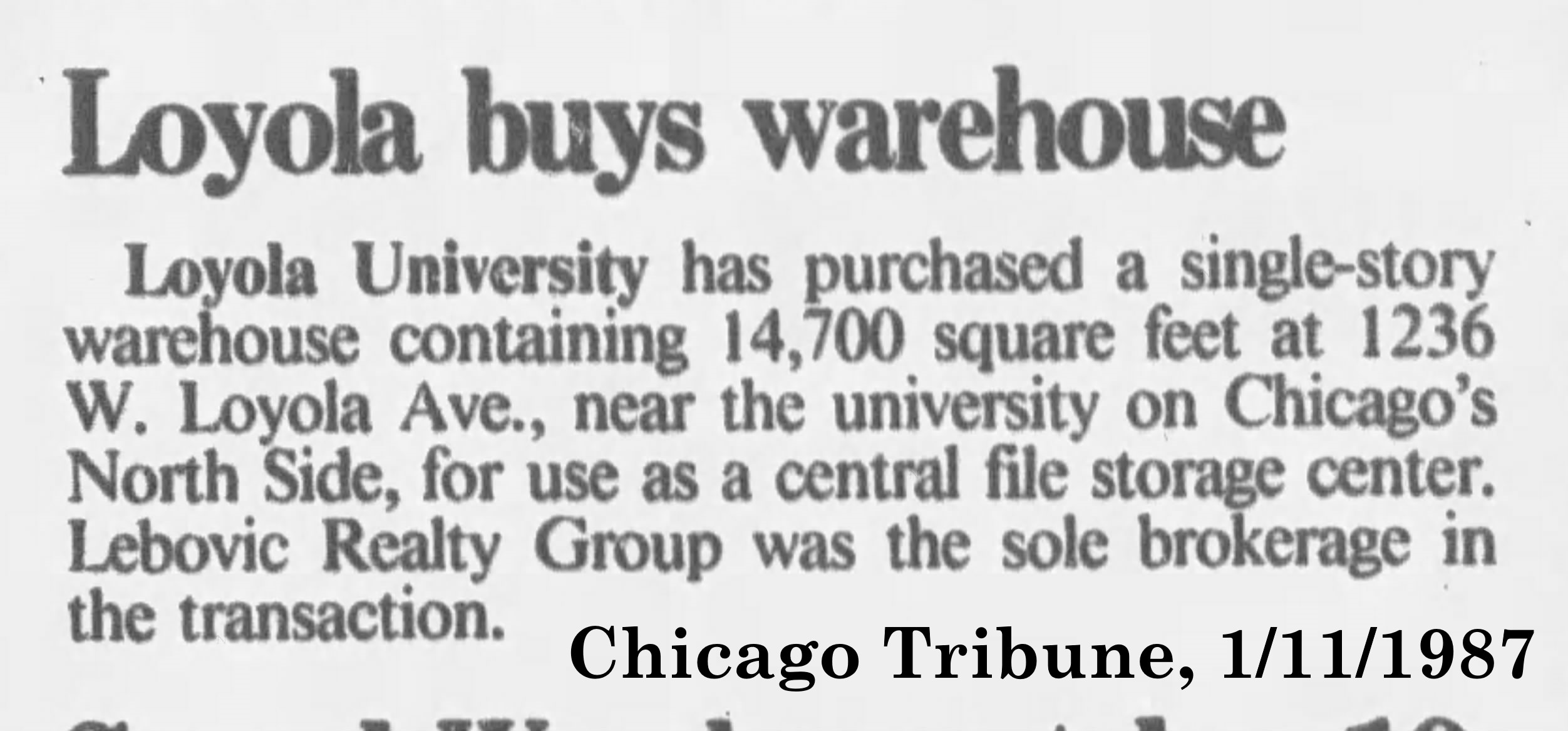
1234 W Loyola is nearly surrounded by other Loyola-owned empty lots, all vacant for over a decade, the project of Loyola whittling down the block beginning in the mid 1990s. It began with 1236, a brick warehouse purchased in 1987 and demolished in 1995, followed by 1235, a 3-story brick residential building pulled down in 1996. Next was 1227, a 3-story brick commercial building knocked down in 2000, and the longest lived were a series of uninspiring, midcentury residential buildings. 1201 a 5-story apartment building demolished in 2008, and finally. two neighboring dorms at 1245 and 1249 came down in 2011. The only whisper of development I can find is a mention in the July 6th, 2010 issue of the Chicago Sun-Times that they wanted to build market-rate housing at 1201, which obviously did not come to fruition. 

I won't hold my breath for new development at 1234 either, unfortunately. Even putting aside Loyola's now-established poor track record, the site lays directly next to the Loyola Red Line Station, which has been targeted for a major renovation in a potential Phase 2 of the Red-Purple Modernization (RPM) project, including a total station rebuild and track straightening. Either of these could easily carve into the edge of the property, and as they sit now all these lots would make appealing staging areas for CTA construction equipment. To be frank, I think we'll be lucky to see anything on these lots in the next decade. 

If you'd like to see more photos of this property, of the photos shown here in higher quality, I've uploaded the full set to Flickr. Also, if you're a fan of regional schlock TV dramas (I use "schlock" lovingly, don't ask me how much Chicago Med I've watched), keep an eye out! This part of the street was recently used for filming on Chicago Fire, though I'm unsure if they used 1234 specifically. (The filming permit says 1241-1201 W Loyola, so they could have been using the other extant building at 1241).

Sunday, January 11, 2026

A Day at Ogden Dunes - Railfanning #1

 One of the many perks of living in Chicago is a great access to railfanning spots. Back in Florida, my best bet was to post up at the one rail crossing downtown, which provided a very welcome bench to rest on but little shade from the beating sun. Thankfully, almost all of Chicagoland's commuter rail network shares track with freight operations, and with a few exceptions they don't care about dorks with cameras loitering on the platform all day, so you can get shaded, comfortable front-row seats all across the city and it's suburbs.

Today's outing was spurred by a more knowledgeable railfan friend of mine, in pursuit of a rare-in-daylight Chicago, South Shore, and South Bend freight, and brought us farther afield, all the way to Indiana on the South Shore Line

Car #101, built in 2001 by Nippon-Sharyo


The South Shore Line largely runs alongside the Metra Electric in the city of Chicago, splitting off past Kensington to make it's first unique stop at Hegeswich on the far east side of the city. While some of their fleet are the same two-level "Highliner IIs" operated by Metra, a good chunk of their trains are older single level EMUs as seen above. It's a fun departure from Chicagoland practice, and to me gives the experience a very Northeasternly vibe, as if I'm riding a SEPTA or NJTransit service. 

Ogden Dunes- or officially, Portage - Ogden Dunes - is a pretty milquetoast station. It was only a flag stop until the late 90s, little more than a strip of concrete and a bus shelter between a small parking lot and the tracks. The modern iteration- built in 1998-99, rebuilt in 2022-24- is not much more inspiring, but is admittedly much more functional, with modern ticket vending machines and strong radiant heaters in the decently-sealed shelters.

Unfortunately the first few trains that thundered through, my photos came out a little "soft". Just had my camera on the wrong preset, it's something I've had happen before, but it's still unfortunate. While I'm not the happiest with them, I'll still throw them up here for the catalog.


The first freight of the day was a CSX mixed freight that came through as my SSL train pulled in. While nothing too special, I still managed to bag a few good spots- 3 Burlington Northern and one CanAmera Foods covered hopper, These are some of my favorite things to photograph, cars still painted for defunct railroads, known as "fallen flags". Burlington Northern merged to create the modern BNSF in late 1996, and CanAmera was bought out and renamed in 2002.
Next up was a Norfolk Southern tanker train, unfortunately nothing interesting for the buffer cars and the tank cars were as unremarkable as they always are. The two units captured at the head here are 1123 (EMD SD70ACe, blt 11/2014), and a margin more interestingly 1823, which started life as a plain jane normal cab SD70 (blt 9/1994), but went under the knife in 2019 to be rebuilt to SD70ACC spec. (DC->AC conversion, safety cab, electrical upgrades).


 Twin GE ES44ACs 4918 and 8891 hail from Kansas City Southern (de Mexico) and the Canadian Pacific Railway, which in 2023 completed the industry's latest mega-merger to form the Canadian Pacific Kansas City (CPKC). I have complicated opinions on the death of America's smallest Class I, but for the time being I'll enjoy getting photos of KCS livery units before corporate starts breaking out the industrial size barrels of red paint.
I'm not a real big fan of tanker trains as they're not much for roster shots or even visually interesting graffiti, but I managed to salvage this one and get a landscape shot I'm very happy with. 
This train wasn't a total wash for roster shots however, as both buffer cars (spacers to keep the hundreds of thousands of gallons of volatile chemicals at least a little bit separated from the locomotives) were quite nice finds. At the front is a CP Rail covered hopper bearing the famous Multimark, a classic piece of late 60s minimalism in corporate design. Later coined the 'Pacman' logo, it was being phased out on new equipment in the late 80s, and so is now quite rare on running equipment. At the rear of the train was another covered hopper of a similar age, bearing the faded green SOUTHERN name- the Southern Railway would merge with the Norfolk & Western in 1982 to form the Norfolk Southern we know today. This is the stuff I love to see honestly, this stuff's only getting rarer as they age and wear out. 
Our next train through featured CSX 6551, built long ago for the Seaboard Coast Line in April 1972. An EMD GP40-2 out of the shops, it was more recently rebuilt to -3 specs by CSX, which gave it the more squared off front end that earned this class it's delightful nickname of Spongebob Squarecabs. Behind it in the consist was a fun patchout centerbeam from Hampton Lumber Sales- I haven't seen many private owner patchouts, so it was a nice find.


Amtrak activity was sparse but I did catch this Siemens SC-44 ("Charger") post collision with a snowman


Next was one of the real stars of the show, an incredibly long mixed freight with some great ancient, crusty covered hoppers. Leading was KCS 4079, a weather beaten EMD SD70ACe (blt 9/2007).
The red covered hoppers here are former Government of Canada cars, just two of thousands furnished by the Canadian government from 1972-1994 to help support domestic farmers. While a 2009 report claimed almost 10,000 still in service, they've begun aging out in the decade and a half since, with retirement ramping up into the 2020s, and these are some of the oldest of that fleet, wearing a once-striking golden wheat logo. I initially thought the blue cars were the stunning Alberta grain hoppers, but further research shows they are former Consumers-Cooperative/Farmland Industries cars, whose venn diagram esque logo can actually be faintly made out on one of the cars, through a fading patch.
The grain hopper buffet continued with a largely intact DM&E car, with the only update being a small RCP&E reporting mark patch. The Rapid City Pierre & Eastern was spun up in 2014 by the Orange Borg to operate a large chunk of the DM&E they acquired from Canadian Pacific, who had purchased DM&E 6 years prior. The train also had a few of these confusing hoppers belonging to the Reading, Blue Mountain & Northern- despite the large, prominent patches, photos of these cars in their past lives show the patches aren't covering anything! They've been anonymous leaser cars their entire lives, coming to RBMN via Progress Rail. Finally, a favorite railroad of mine that we'll be seeing more of later: Conrail! Always a delight to find their cars; note this "CoilSHIELD™" cover is actually matched to a Norfolk Southern car. The covers on these coil cars are a separate piece that can be mixed and matched to some extent. 
Leading the next freight was NS 4500, which started life as a GE C40-9W ("Dash 9"), built 3/1998. In 2021, it was rebuilt into an "AC44C6M", which among other upgrades converted the traction motors from DC to AC, which gave these units fun little DC to AC badges on the cab. Trailing is 1225, an EMD SD70ACe, delivered for Progress Rail's lease fleet but never operated by them before being repainted for NS in 2022.
While the liveries here are all pretty basic, they made up for it with some good graffiti. Some people really hate it, and I admit it can often be pretty tacky, but I love the variety it brings back to boring, plain sided cars like these. The "Cyro Trans" reefers in the latter pictures are special because they use liquified CO2 refrigerant to deep freeze their contents, as opposed to simpler cars that just keep stuff regularly refrigerated. The rainbow text is also a nice pop of color, and the names provide some spotting interest. From what I can find the names are assigned somewhat arbitrarily, sometimes at the request of a shipper who commonly uses that car. The two here are 4070 "Door County" (a county in Wisconsin), and 5352 "Dickson".
A brief relief from the normal black tankers were these Procor cars. I initially thought the paint scheme implied some kind of special service, but this doesn't seem to be the case.
In an age of heavy duty, high horsepower units, NS 7144 trundling through with a short rake of tankers was a charming sight. This locomotive is an EMD GP60, built December 1991, and has the "normal cab" I refered to early in this post.
Next was another nice smaller freight, with Indiana Harbor Belt 5627 and 5629, which I'm told almost always travel in this pair. They're a great illustration of the incredibly long lives North American freight locomotives live, as both are 1971 builds for two different northeastern railroads that disappeared in 1976 as part of the government-backed buyout that formed Conrail. 5627 started life for the Lehigh Valley, an ailing coal road that struggled to find a new footing, and 5629 was a rare new build for the hopelessly incompetent and near-instantly bankrupt Penn Central

Some decent coil cars in this batch as well. Note the IHB cover matched to a NOKL (Northwestern Oklahoma RR) flatcar, compared to the BNSF "Coil Car E-XL", with a stenciled note that it should only ever be matched to a complimenting BNSF car. 


One train we'd been watching slowly crawl it's way up the tracks was a tie train headed by this unique LORAM unit. Maintenance of Way "locomotives" like these are real cryptids of the modern railroad world- best I can tell this is a "SPS" or "Self Powered SlotMachine", built and operated by LORAM. What powers it and if any secondhand parts underpin it is just a mystery. 
Now while the advertising copy linked above shows off the SPS with a shiny block of specialty gondolas, we were lucky enough to get this one with a motley collection of maintenance of way cars. MofW equipment, only ever being used to maintain the tracks it already resides on, almost never has to be interchanged to another railroad, and is therefore not lifespan-limited by AAR interchange rules. Simply put, these things are older than dirt. If your dad has a sagging pickup truck that he uses to drag things around the yard, or your local junkyard has an oil-burning minivan they use to transport parts to the sales desk, thats what these are in railroad form.

You'll note that 3 of these cars haven't even had their reporting marks changed over from "CR" for Conrail, which was divvied up between NS and CSX in 1999. CR 56205, with the excavator perched on top, is ex-Penn Central, possibly even ex-New York Central, as it's stenciled as a G44A Class. CR 56285 is ex-Pennsylvania Railroad 442530 (likely built 1966!). Outlier NS 194776 is still old, being ex-Southern 52776. CR 598758 is also ex-Penn Central, built 1972. This entire train was either ancient CR or NS gons, I've trimmed the list here for brevity but I'm hoping to put together a full listing in the future- as rusty and beat up as they are, these are some of my favorite finds of the day.


The excavator here was perched on the gondolas, slowly grabbing piles of old ties off the trackside as the Loram unit at the head grumbled along. Fun to watch! Not to listen to, my poor ears.
One more handful of grain hoppers for the road! Some good ones here too, including a Farmers Marketing Association car and a Peavey car. Those two are both likely from the 1970s or 1980s- these private owner advertising cars were popular around then for the former, and for the latter, Peavey was hoovered up by ConAgra in 1982, which likely put an end to new applications of the name.


Just before we left, not wanting to spend another two hours on the platform hoping for a Chicago South Shore & South Bend train we weren't even sure would arrive in daylight, (it ultimately didn't) the most comical consist I've ever seen rolled past. Three whole locomotives- NS 4630, 8087, and 4703, 13,200 raw American horsepower, thundered down the line with a whole 5 cars. God bless America.


That spells a wrap for this trip! Hopefully you enjoyed reading. I'm hoping to get more blog posts out for 2026, if I'm lucky I'll even make a dent in my backlog. If you're interested in more photos from this trip, or these photos in higher resolution, they'll hit Flickr in full quality Eventually™.


Ravenswood Presbyterian Church - 4300 N Hermitage Ave

 We're going to have to go posthumously (postarchitecturally?) on this one. As this blog post is written, the walls have already fallen ...