Sunday, May 31, 2026

And Lo The Renewal Became The Renewed - Royal George Theatre


The Royal George Theatre (1641 N Halsted) opened in 1986, the project of one Royal Faubion1, a Hinsdale-based developer who originally drafted a mixed-use development with a 200-seat theater to "anchor" the retail stores and attract tenants and customers alike. With the influence of theater producer Michael Cullen, this grew, and grew, and eventually devoured the whole lot to become a standalone theater, featuring a 450-seat 'main stage', a 200 seat cabaret theater, a 100 seat 'great room', and a 50-seat black box theater.. The name "Royal George", was in the time honored tradition of mashing the proprietors names together- Royal Faubion, and his secretary-soon-wife, Georgean Jones.

Credit Library of Congress/Sanborn Map Co. 

The theater broke ground on July 16th, 1985, on a freshly cleared lot in a then backwater of the rapidly gentrifying Lincoln Park. The total development spanned 7 "standard" city lots, pictured above in a 1935 Sanborn map, with only the the southernmost building at 1633 N Halsted remodeled into the Cafe Royal. The rest- 4 brick and 2 wood framed primarily residential buildings- were bought out and demolished. As with most vernacular buildings lost to urban renewal, sifting through the newspapers only brings up scattered details- a small grocery store at 1639, the apartments at 1643 being converted into SROs, and countless 'looking for work' ads from tenants of every building in every era.

1649 N Halsted in 1961 - Credit Loop North News/Don DeBat

We do have a valuable history and photograph of one building- 1649 N Halsted, replaced unceremoniously with a parking garage ramp for the Royal George. Our information here comes from Loop North News contributor Don DeBat, whose father purchased the property in 1948, and lived there for decades before it was purchased for the theater's construction. If you're curious, the building- originally split into tiny, four-room one bedroom apartments, was purchased for $4,800 (~$67,000), and later sold $40,000 (~$126,000). The article, written around the time the theater's redevelopment was first discussed in 2022, is an interesting reflection of a lost era of Lincoln Park, and I invite you to thumb through it for a more detailed description of the humble balloon-frame, clapboard building illustrated above. 

The former site of 1649 N Halsted; note the surviving neighboring building


Architects Lisec & Biederman were brought in to draft the new theater's design, with allusions made to it being a 'theater in the old style', with an italianate design to blend into the area's remaining historic structures. I will excise some of the harsher criticism contained in earlier drafts of this post, but overall I find the Royal George rather mediocre. Lisec & Biederman would go on to make more projects in this style, like the Bloomsbury townhomes (5230 S Cornell, 1988), and I think they only improved with time.  The Royal George by comparison feels like it's had all its details pressed flat back into it's facade, giving it the air of a cheap pressed veneer rather than Italianate craftsmanship.

Theater interior - Source: lisecarchitects.com (archived)

After a short period of previews, the Royal George opened on December 3rd, 1986 with Little Shop of Horrors, marking the complex as complete (the adjoining restaurant, The Royal Cafe, had opened a year prior). Royal Faubion however was not one to rest on his laurels, as in August 1988 he announced he was already embarking on a second theater complex, right across the street at 1630-1650 N Halsted. Set to contain new homes for both the prestigious Steppenwolf and Second City theater companies, it doesn't seem to have gotten much farther than breaking ground before things rapidly began to fall apart. Second City bailed that fall, deciding they'd instead stay at their then-and-now current location at 1616 N Wells, and Steppnewolf was not long behind them, formally bailing on Faubion's project on March 9th, 1989. The plan was basically fully scrapped by the summer, when the Steppenwolf 'stepped' back into the picture, buying their slice of the project to build their new theater themselves, and Faubion made out with only a parking garage on the south end of the property.2

Back at the Royal George, the producers of multiple shows weren't being paid, culminating in the producers of Steel Magnolias seizing box office revenues after a $64,000 check bounced in early 1989, and by February Faubion had admitted to the press that he owed "a lot of money". The theater was listed for sale in early March, and would go briefly dark in mid 1989 before being rented to a new management company run by Robert Perkins, reopening in late 1989 with The Cocktail Hour and Cowardly Custard (Perkins would later buy the theater outright in 1994 with Broadway theater producer Rocco Landesman3). The Cafe Royal, who's floundering finances were one of the speculated reason's for Faubion's money troubles, also turned over at this time to the fantastically bland-named "Halsted Bar & Grill". 


The game of hot potato would finally end in 1998, when it traded hands to it's final owners, Reading Entertainment.4  With this the theater could finally settle into truly regular operation, and from what I've found during my research it was a pretty popular space in the Chicago theater scene. The neighboring restaurant would continue to trade names, culminating with Balena, an Italian restaurant run by Boka Restaurant Group and B. Hospitality Co, which operated until 2017, when it suffered a devastating fire. The space would be locked in insurance back-and-forth for a further two years before the owners gave up on reopening it in 2019, and it laid vacant until the building's demolition.

The Royal George itself would continue as usual until the Covid-19 pandemic, with the theater closing in March ahead of the premiere of Hit Her With The Skates, with show pages cheerfully noting the theater "Will Be Back Soon". After a year in stasis, owners Liberty Theatres5 told the producers of the venues last shows they had until April 11th, 2021 to have their equipment removed, as they were prepping to sell the building for redevelopment. A deal was made by June that year, selling the property to Draper & Kramer of Chicago, IL, From there, work entered a frustrating but familiar rhythm- plans would be announced a year later, approved another year after that, and it would take another two agonizing years before the excavators of Precision Excavation would roll up to the site in late November 2025.


My first visit came the day after demolition permits were granted on November 1st, 2025, as I was still attempting to 'keep up with the Joneses' in respect to Chicago demolitions. That was a venture I quickly burnt out on, and so my coverage ended up a bit spotty. The photo above, taken on November 23rd, shows the earliest demolition work, removing the 1980s connecting building built by Faubion. 


By the time I broke out of a mixed holiday cheer and seasonal depression stupor and returned in February, the site had been almost fully cleared, saved for the stubborn remains of the parking garage. A post from @BuildingChi on Twitter shows that demolition had reached the main theater building by the 3rd.


The parking garage would hold on into March as excavators gnawed away at the steel-reinforced concrete, but the last remnants of the early pioneer of an off-Loop theater revival would soon fade. 

Architectural rendering via Draper & Kramer and SGW Architecture & Design

The approved design, an eight-story mixed use building with a sawtoothed glass facade, is quite nice in my opinion, and does also come with 20 units of affordable housing. The rendering above is also interesting as it includes an approved but seemingly abandoned neighboring development, 1623 N Halsted, that would have knocked out the remaining buildings between the Royal George and the tracks for a similar if less eye-catching 7-story mixed use building.

At time of writing, the site has been fully cleared, though construction has not begun in earnest. I can only wish them luck, as I love to see any residential development that isn't adding to the city-draining trend of deconversions and demolitions for single-family-homes, of which Lincoln Park is particularly infested.

If you'd like to see all the photos I've taken at this site, you can find them here on Flickr
A list of sources can be found here

    1. Up for grabs if anyone's looking for a drag name
2. A proposed "European style" hotel never seemed to materialize; if I had to speculate, this would have gone in the space between the garage and the Steppenwolf that later became the Arts & Education Center. 
3. I found record of a supposedly done-deal in 1992 for the theater to be purchased by real estate lawyer Jerry Schain, who wanted to rename it "Hollywood on the Lake"; it appears nowhere else in newspapers I can find after it's initial announcement.
4. The legal successor of the Reading Railroad, established all the way back in 1833!
5. Reading's live theater subsidiary


Sunday, February 1, 2026

Ravenswood Presbyterian Church - 4300 N Hermitage Ave

 We're going to have to go posthumously (postarchitecturally?) on this one. As this blog post is written, the walls have already fallen on Ravenswood Presbyterian, and the last stones have been tidily rounded up into plastic-wrapped pallets for resale.


October 2025 was a bad month for vacant Chicago churches- perhaps unsurprising for the spookiest month of the year. Almost one after another, demolition permits fell for both Ravenswood Presbyterian, and the even older Christ Lutheran in Logan Square. While I was able to snag photos of both, I got much more complete coverage of Ravenswood, and for coverage of Logan Square I can happily direct you to Postcard-Past's wonderful writeup.
When I arrived on November 1st, the green demolition fencing had already gone up, somewhat thwarting my efforts to get a "clean" complete survey of the building. I'm very happy with the first shot however- the fall colors helped create a really beautiful scene.

Obscured by the fencing was the building's cornerstone, which attested the building was built 1914, and I was able to turn up contemporary newspaper reports that the new chapel was formally dedicated on March 28th, 1915, by pastor Frederick R Seldon. Valued at an impressive $82,000, (roughly $2.6 million in flimsy modern day funbucks), it partially replaced a 1906-1907 structure the congregation had used previously. This was technically the congregation's third home however, as they had first organized in 1902 and met at the now-lost Library Hall.


Little is known about this first iteration- I was able to track down this photo from the Chicago Public Library's collection, which claims to be Ravenswood Presbyterian at Cullom & Hermitage, but it carries very little information (not even a date), and it scarcely resembles a church at all. My best guess is that this is the 1906 structure, possibly in it's later use as a supplemental facility, and the oddness comes down to poor photography and reproduction over the years.


I think our best chance at an "as built" of Ravenswood Presbyterian is to turn to the architect's other works. Pond & Pond was quite prolific, and three years later they built another Presbyterian church, this time in Albany Park, which survives largely intact as a mosque. While not exact replicas, the buildings share a very similar shape, and I want to make special note of the similarity of the pane windows along the side.

Chicago Tribune, May 5th, 1949

The church was heavily rebuilt in 1949, demolishing the old parish house to add a 2-story annex, and re-cladding the main church in lannon stone, at a cost of $300,000 ($4.1 million, adjusted). The early rendering shown here is interesting as a lot changed between this sketch and reality- notably, no unexposed brick survived the remodel in the end, and the stone used was of a irregular, cobbled type, rather than the stone blocks seen used primarily as an accent here.

The church continued on through the decades as the neighborhood shifted; an anecdote in a Chicago Tribune article claims that in 1979, the church had a congregation of about 500, still mostly white, but that the church had welcomed it's first Hispanic members in 1968. By the time that article was written in 2003, the church's congregation, shrunk to 150, was now predominantly Hispanic, and the church's services were fully bilingual. A 2008 article even discusses the church opening it's doors to the LGBT community, which feels pretty progressive for the time; the church itself had adopted the moniker "The church of the open door" to reflect these policies, though the congregation continued to dwindle- down to 110 by that later article.

By 2024, the church made the decision to sell, joining with Mayfair Presbyterian, another stone-clad church further on the NW side. While they'd kept their head above water, maintenance costs mounted for such a large property, and the Hispanic families that had come to redefine the church had mostly been forced out as Ravenswood harshly gentrified. The church was first put up for sale in October 2024, and finally sold in June 2025 for $4.375 million.
Peeking over the fences, I still managed to line up some detail shots. Sadly, based off demolition photos, none of these windows or doors were salvaged, and were all destroyed.


Demolition wouldn't start for a short while, but an excavator had already taken up residence in the parking lot behind the building. However, this humble parking lot would turn out to be an unexpected boon, but we'll get to that in a second.


Our last view behind the fences is the only one  not coated with green demolition netting, standing in front of a small church garden. For some reason this in particular struck me as really sad- obviously the whole property was the product of many people's massive efforts (the inflation-adjusted millions to build and rebuild it for starters), but this garden was probably one or two people's baby, specifically. And here it sits, left to seed and now churned under the soil for suburbia in the city, that probably won't even have flowers in the front yard.


Through some incredible luck, a series of unlocked gates let me into the church property, including the church interior, which had sat fallow since the congregation left in late 2024. Above is the caretaker's house, a cute & squat little structure, likely built as part of the 1949 renovation. Sitting at the edge of the property, it was also the first to fall, being totally gone by December 10th.
Access to the rest of the property came via this passageway in front of a sunken courtyard, a fun architectural flourish, meant to provide natural light per an article on the 1949 renovations. That article also called this a "sunken garden", so perhaps the stone pavers were a later addition when that became too high maintenance.
The rear annex was pretty plain inside, but still had some nice details like the midcentury fireplace. I think these photos show a mix of school and general meeting rooms. I'm not sure what's with the missing baseboard in several of these photos- it'd be a strange thing to salvage.
This is the "Frederick R Selden Chapel", named for the founding pastor, who was still alive at the time it was built but had retired to Wisconsin. The first photo is by William C Lowe for the Chicago Tribune, October 19th, 1950.


While a lot of the church had been cleared out, this room was still full of haphazardly stacked old pews and clumps of old carpet. When organizing these photos I realized these might be from the curiously empty chapel above, perhaps a casualty of a remodel delayed by Covid and ultimately killed off by the church's closure, but I can't know for certain.


Making our way to the front of the church, we can find some posters still clinging to the walls, including some from the height of the pandemic. The sunlight was nice here, as some of my other photos turned out rather soft due to the minimal light.


Enough of that sunlight though! Before we finish our tour in the sanctuary, we're going to dip down into the basement, another feature of the 1949 remodel. Like the storage room above ground, this area was still relatively well stocked, especially with the drying racks full of mugs. While photographing a doomed building from the outside is sad enough, walking through a part of it that still felt "lived in" provided a much stronger melancholy. 
Finally we'll enter the sanctuary. I've included another news photo here for comparison, by Alex V. Hernandez for Block Club Chicago's coverage of the church when it was first put on the market. While I'm sure most of it is down to photo quality and time of day, what strikes me between the two photos is how hollow and lifeless the space feels, with the banners taken down and the pews scattered like the opening to some apocalyptic movie.
Some more detail shots here, of the sanctuary. While not as grand or historic as some other Chicago churches, even among the ranks of recent losses, it's impossible to not look at this and see what a shame it is to just tear it all down. Residential conversion of churches can be tricky, but it's far from impossible, and failing that there's still great opportunity to repurpose them as community spaces- arts centers, soup kitchens, the like. However those kinds of operations rarely have a cool $3 million and change sitting around, so they lose the bidding war.

My coverage of the demolition itself isn't great, despite being adjacent to the Brown Line it wasn't massively convenient from my afterwork commute, and the early sunsets meant I didn't have many chances to get those photos in good lighting. Nonetheless I did manage a stop in on December 12th for a few gray snapshots.


From this angle, you'd be forgiven for thinking that nothing has changed, except for the loss of the warm fall foliage.


Turn the corner and meander down the alley however, and the progress becomes clear. A large chunk of the annex laid in rubble, and a pickup truck sat quietly idling as men in reflective vests loaded bathtubs and appliances for scrap. This was my last visit to the property, but some photos from later in the year can be found here, and into the new year here showing the progression of demolition into the sanctuary.

In a disappointing reinforcement of the very same trends that drove the church out, the new development here will be six luxury single family homes, the first of which was permitted on January 20th, 2026. While the price of these units isn't known, we can use the market as a point of comparison- a more Craftsman styled 2013 newbuild, nearby on Paulina, cleared for $1.7million in 2024, with a current estimated value of $1.9million. So the developers will likely make off with a tidy profit even with only 6 homes.

I gotta find a more positive story for the next architecture piece I write....

UPDATE: I've finally gotten all the pictues uploaded to Flickr, if you'd like to see everything in full quality. LINK

FURTHER READING

SOURCES


Tuesday, January 13, 2026

Dead at 100 - 1224-1234 W Loyola Ave

As reported by Preservation Chicago and confirmed by a check of city permits, demolition is finally moving forward at 1224-1234 W Loyola Ave, directly west of the Loyola Red Line station.

Loyola University purchased the building in early 2024, sparking a small flurry of news coverage as they were very transparent that they had bought it as a distressed property with the intention to demolish it as soon as the last lease wrapped up. This caused quite an uproar, both from beloved commercial tenants like Archies Cafe, and even moreso to many of the residential tenants who lived upstairs. Many of them were long time tenants, living in the building for over a decade, some on fixed incomes who were unsure of how they would find new housing in a freshly popular neighborhood like Rogers Park. Reporting from the Chicago Reader showed that in October 2023 studio and 1 bedroom units in the building ranged from $460-$825, a price that they couldn't match on any apartment listing site, with only 1 apartment nearby found under $1.000. A modern review shows only 3 properties that come close to this criteria, all studios ranging from $700 to $870; funnily enough, two of these properties- Lakeside 6241 and The Sovereign, both in Edgewater, are owned by Loyola. 

Now, this came at a cost of course. Loyola didn't get it at a discounted price and immediately announce it's demolition because it was a well kept building- the Chicago Reader piece above notes that Jennifer Clark, director of neighborhood initiatives at Loyola University said "not one of the two dozen residential tenants she has spoken with liked living in the building.", and a review of code inspections- particularly several in 2006-2007- show a rather shocking number of violations for structural damage, and a 2024 inspection reported notable damage to the building's fire escapes. Unfortunately crappy buildings are an essential part of our broken housing system, and the loss without replacement of these buildings impacts the community all the same. In a city with a blazing hot real estate market and a terminal shortage of public housing or even homeless shelter beds, it's entirely possible former tenants here ended up on the street. 

It is also a loss for the city's architectural fabric. This was never meant to be a particularly notable building, but the first floor is chock full of architectural detail, with dotted twisting pillars and a quatrefoil sash framing each storefront. Even lauded, traditionally styled new developments like those at 4907 North Paulina in Uptown or 3746-3766 South Michigan in Bronzeville lack this finer ornamentation, and whatever Loyola eventually puts here will likely follow the "cleaner" aesthetic currently favored by colleges.

On that note, what will Loyola eventually put there? Well, nobody knows. Contemporary coverage at the time of the sale indicated that they have no plans for the site, aside from some vague allusions towards making it "green space". The surrounding area doesn't give much hope either; 

Base map credit OpenStreetMap


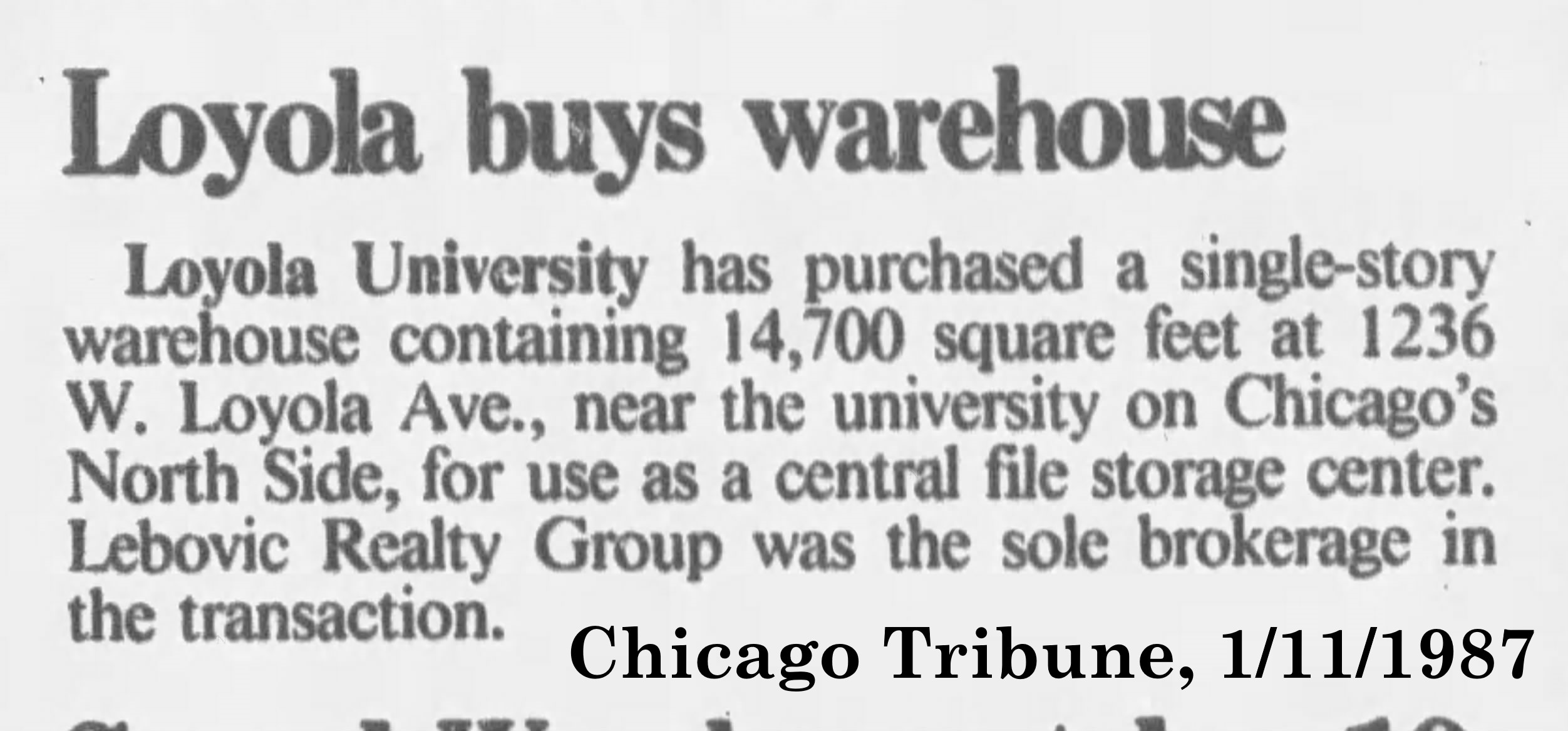
1234 W Loyola is nearly surrounded by other Loyola-owned empty lots, all vacant for over a decade, the project of Loyola whittling down the block beginning in the mid 1990s. It began with 1236, a brick warehouse purchased in 1987 and demolished in 1995, followed by 1235, a 3-story brick residential building pulled down in 1996. Next was 1227, a 3-story brick commercial building knocked down in 2000, and the longest lived were a series of uninspiring, midcentury residential buildings. 1201 a 5-story apartment building demolished in 2008, and finally. two neighboring dorms at 1245 and 1249 came down in 2011. The only whisper of development I can find is a mention in the July 6th, 2010 issue of the Chicago Sun-Times that they wanted to build market-rate housing at 1201, which obviously did not come to fruition. 

I won't hold my breath for new development at 1234 either, unfortunately. Even putting aside Loyola's now-established poor track record, the site lays directly next to the Loyola Red Line Station, which has been targeted for a major renovation in a potential Phase 2 of the Red-Purple Modernization (RPM) project, including a total station rebuild and track straightening. Either of these could easily carve into the edge of the property, and as they sit now all these lots would make appealing staging areas for CTA construction equipment. To be frank, I think we'll be lucky to see anything on these lots in the next decade. 

If you'd like to see more photos of this property, of the photos shown here in higher quality, I've uploaded the full set to Flickr. Also, if you're a fan of regional schlock TV dramas (I use "schlock" lovingly, don't ask me how much Chicago Med I've watched), keep an eye out! This part of the street was recently used for filming on Chicago Fire, though I'm unsure if they used 1234 specifically. (The filming permit says 1241-1201 W Loyola, so they could have been using the other extant building at 1241).

And Lo The Renewal Became The Renewed - Royal George Theatre

The Royal George Theatre (1641 N Halsted) opened in 1986, the project of one Royal Faubion 1 , a Hinsdale-based developer who originally dra...