We're going to have to go posthumously (postarchitecturally?) on this one. As this blog post is written, the walls have already fallen on Ravenswood Presbyterian, and the last stones have been tidily rounded up into plastic-wrapped pallets for resale.
.jpg)
October 2025 was a bad month for vacant Chicago churches- perhaps unsurprising for the spookiest month of the year. Almost one after another, demolition permits fell for both Ravenswood Presbyterian, and the even older Christ Lutheran in Logan Square. While I was able to snag photos of both, I got much more complete coverage of Ravenswood, and for coverage of Logan Square I can happily direct you to Postcard-Past's wonderful writeup.
 |
 |
When I arrived on November 1st, the green demolition fencing had already gone up, somewhat thwarting my efforts to get a "clean" complete survey of the building. I'm very happy with the first shot however- the fall colors helped create a really beautiful scene.
Obscured by the fencing was the building's cornerstone, which attested the building was built 1914, and I was able to turn up contemporary newspaper reports that the new chapel was formally dedicated on March 28th, 1915, by pastor Frederick R Seldon. Valued at an impressive $82,000, (roughly $2.6 million in flimsy modern day funbucks), it partially replaced a 1906-1907 structure the congregation had used previously. This was technically the congregation's third home however, as they had first organized in 1902 and met at the now-lost Library Hall.

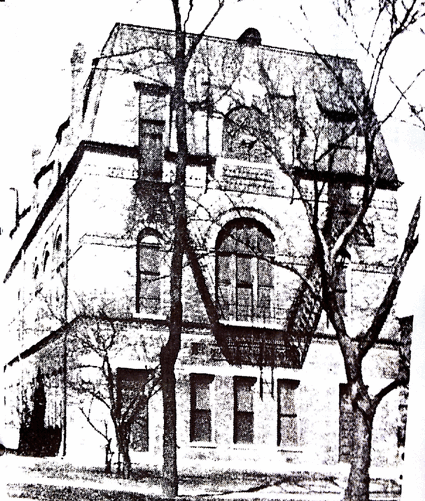
Little is known about this first iteration- I was able to track down this photo from the Chicago Public Library's collection, which claims to be Ravenswood Presbyterian at Cullom & Hermitage, but it carries very little information (not even a date), and it scarcely resembles a church at all. My best guess is that this is the 1906 structure, possibly in it's later use as a supplemental facility, and the oddness comes down to poor photography and reproduction over the years.

I think our best chance at an "as built" of Ravenswood Presbyterian is to turn to the architect's other works. Pond & Pond was quite prolific, and three years later they built another Presbyterian church, this time in Albany Park, which survives largely intact as a mosque. While not exact replicas, the buildings share a very similar shape, and I want to make special note of the similarity of the pane windows along the side.
 |
| Chicago Tribune, May 5th, 1949 |
The church was heavily rebuilt in 1949, demolishing the old parish house to add a 2-story annex, and re-cladding the main church in lannon stone, at a cost of $300,000 ($4.1 million, adjusted). The early rendering shown here is interesting as a lot changed between this sketch and reality- notably, no unexposed brick survived the remodel in the end, and the stone used was of a irregular, cobbled type, rather than the stone blocks seen used primarily as an accent here.
The church continued on through the decades as the neighborhood shifted; an anecdote in a Chicago Tribune article claims that in 1979, the church had a congregation of about 500, still mostly white, but that the church had welcomed it's first Hispanic members in 1968. By the time that article was written in 2003, the church's congregation, shrunk to 150, was now predominantly Hispanic, and the church's services were fully bilingual. A 2008 article even discusses the church opening it's doors to the LGBT community, which feels pretty progressive for the time; the church itself had adopted the moniker "The church of the open door" to reflect these policies, though the congregation continued to dwindle- down to 110 by that later article.
By 2024, the church made the decision to sell, joining with Mayfair Presbyterian, another stone-clad church further on the NW side. While they'd kept their head above water, maintenance costs mounted for such a large property, and the Hispanic families that had come to redefine the church had mostly been forced out as Ravenswood harshly gentrified. The church was first put up for sale in October 2024, and finally sold in June 2025 for $4.375 million.
 |
 |
 |
 |

Demolition wouldn't start for a short while, but an excavator had already taken up residence in the parking lot behind the building. However, this humble parking lot would turn out to be an unexpected boon, but we'll get to that in a second.

Our last view behind the fences is the only one not coated with green demolition netting, standing in front of a small church garden. For some reason this in particular struck me as really sad- obviously the whole property was the product of many people's massive efforts (the inflation-adjusted millions to build and rebuild it for starters), but this garden was probably one or two people's baby, specifically. And here it sits, left to seed and now churned under the soil for suburbia in the city, that probably won't even have flowers in the front yard.

Through some incredible luck, a series of unlocked gates let me into the church property, including the church interior, which had sat fallow since the congregation left in late 2024. Above is the caretaker's house, a cute & squat little structure, likely built as part of the 1949 renovation. Sitting at the edge of the property, it was also the first to fall, being totally gone by December 10th.
 |
 |
 |
 |
 |
 |
 |  |

While a lot of the church had been cleared out, this room was still full of haphazardly stacked old pews and clumps of old carpet. When organizing these photos I realized these might be from the curiously empty chapel above, perhaps a casualty of a remodel delayed by Covid and ultimately killed off by the church's closure, but I can't know for certain.

 |
 |
 |
 |
|

Enough of that sunlight though! Before we finish our tour in the sanctuary, we're going to dip down into the basement, another feature of the 1949 remodel. Like the storage room above ground, this area was still relatively well stocked, especially with the drying racks full of mugs. While photographing a doomed building from the outside is sad enough, walking through a part of it that still felt "lived in" provided a much stronger melancholy.
 |
 |
 |
 |
 |
 |
My coverage of the demolition itself isn't great, despite being adjacent to the Brown Line it wasn't massively convenient from my afterwork commute, and the early sunsets meant I didn't have many chances to get those photos in good lighting. Nonetheless I did manage a stop in on December 12th for a few gray snapshots.

From this angle, you'd be forgiven for thinking that nothing has changed, except for the loss of the warm fall foliage.

Turn the corner and meander down the alley however, and the progress becomes clear. A large chunk of the annex laid in rubble, and a pickup truck sat quietly idling as men in reflective vests loaded bathtubs and appliances for scrap. This was my last visit to the property, but some photos from later in the year can be found here, and into the new year here showing the progression of demolition into the sanctuary.
In a disappointing reinforcement of the very same trends that drove the church out, the new development here will be six luxury single family homes, the first of which was permitted on January 20th, 2026. While the price of these units isn't known, we can use the market as a point of comparison- a more Craftsman styled 2013 newbuild, nearby on Paulina, cleared for $1.7million in 2024, with a current estimated value of $1.9million. So the developers will likely make off with a tidy profit even with only 6 homes.
I gotta find a more positive story for the next architecture piece I write....
UPDATE: I've finally gotten all the pictues uploaded to Flickr, if you'd like to see everything in full quality. LINK
FURTHER READING
- Mujeristas: A Name of Our Own!!, Ada Maria Asisi-Diaz for Christian Century, 5/24-31/1989, a truncated online article about mujerista theology, a feminist & liberation theology of which current Ravenswood Presbyterian pastor Rev. Magdalena Garcia was a proponent.
SOURCES
- First Single Family Residence Permit On Ravenswood Presbyterian Church Site Added To Chicago Data Portal, Daniel Schell for Chicago YIMBY, 1/22/2026
- Demolition Imminent For Former Ravenswood Presbyterian Church, Daniel Schell for Chicago YIMBY, 10/23/2025
- Ravenswood Presbyterian Church Property For Sale As Parish Plans Move To Mayfair, Alex V Hernandez for Block Club Chicago, 10/4/2024
- Healing minds is its mission, Sue Ellen Christian for Chicago Tribune, 2/4/2000
- Keeping the door wide open, Melissa Patterson for Chicago Tribune, 7/4/2008
- In 2 languages, carolers sing as one, Richard Knight Jr for Chicago Tribune, 12/21/2003
- CHURCH PLANS NEW $225,000 PARISH BUILDING, Leigh Atkinson for Chicago Tribune, 5/5/1949
- @BuildingUpChi, Twitter, 12/10/2025
- @BuildingUpChi, Twitter, 12/29/2025
- DEDICATE NEW CHAPEL IN RAVENSWOOD TODAY, Chicago Tribune, 10/15/1950
- Special Programs Mark Remodeling of Ravenswood Presbyterian Church, Chicago Tribune, 10/19/1950
- Ravenswood to Have New Church, Chicago Tribune, 2/7/1914
- Pastor of Church Dedicated Tomorrow, Chicago Tribune, 3/27/1915
- Tell Ravenswood Church Plans, Chicago Tribune, 5/5/1949
- Ravenswood Presbyterian Church, Ravenswood-Lakeview Historical Association, 3/15/2013
- Ravenswood Presbyterian Church, Explore Chicago Collections
- LOSS: Ravenswood Presbyterian Church Demolished For New Single Family Homes, Preservation Chicago, 11/30/2025
- Pond & Pond Collection, c1895-1938, Ryerson and Burnham Art & Architecture Archive, Art Institute of Chicago

.jpg)

.jpg)